Overview
A vacuum is only as clean as the air that leaves it. Without a fine exhaust filter, the smallest particles pass straight through the bag and motor and are blown back into the room, where they settle on surfaces again within hours.
This H13 HEPA filter sits after the main filter and captures at least 99.95% of particles at the most penetrating particle size. It is the right choice for offices, schools, healthcare settings, hotels and any site where people with allergies or asthma work.
Where to use it
The H-300 fits Scrubtec compact tub vacuums of 15 to 30 litres. The H-400 fits the larger wet-and-dry vacuums of 30 to 80 litres, with a bigger media area to match their higher airflow.
- Office, school and hotel cleaning
- Healthcare and care home housekeeping
- Cleaning after light building work and fit-outs
- Sites with allergy or air quality requirements
Design and construction
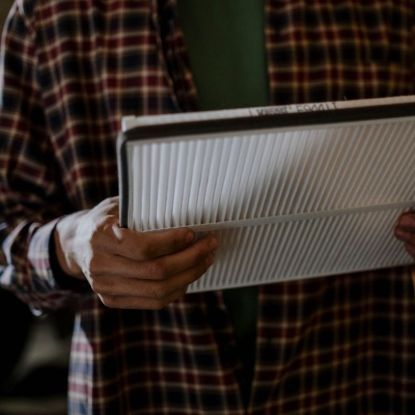
The media is pleated glass fibre, tested to EN 1822. Deep pleats give a large filter area in a small frame, which keeps the pressure drop low and the suction strong. A rigid polypropylene frame holds the pleats in shape, and a soft polyurethane gasket seals the filter into its housing so no air can go round it.
Each filter is individually tested and carries a label with its class and part code.
Fitting and care
Switch off and unplug the vacuum. Open the exhaust filter cover, lift out the old filter and wipe the housing and seal face with a dry cloth. Fit the new filter with the gasket facing the machine and close the cover until it locks.
HEPA media cannot be washed, tapped out or blown clean with compressed air; all three damage the fibres and the seal. Replace the filter when suction falls even though the main filter and bag are clean, or at least once a year in daily use.
- Never wash or blow out a HEPA filter
- Check the gasket is seated all the way round
- Bag the old filter before disposal
- Keep the main filter clean to extend HEPA life
Dust class and compliance
The filter element meets H13 on its own. The dust class of the vacuum, such as L, M or H, depends on the whole machine and is shown on its rating plate. Fitting this filter doesn't upgrade a vacuum to a higher dust class, but it does restore the filtration it was built with.
For hazardous dusts such as silica or wood dust, always use a vacuum that is certified for that dust class.
Ordering
Filters are packed singly in a sealed bag inside a carton, so they stay clean in a service van. Order by the part code on the old filter. Trade accounts can add them to a saved list and reorder with quick order alongside bags and other consumables for the vacuum fleet.
Demo product: invented for the Cartenvo B2B demo store.