Product overview
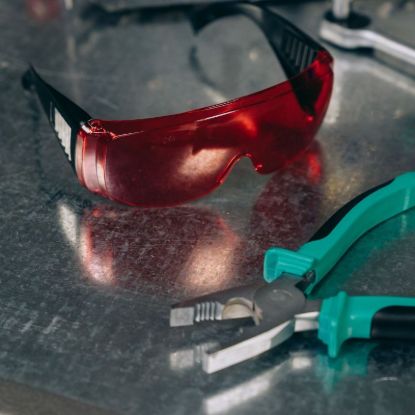
Goggles give a closer seal than safety glasses. The flexible PVC body sits against the face all round the eyes, so dust, droplets and chips cannot get in from the sides, top or bottom. The wide lens gives a clear field of view to the sides as well as straight ahead.
The elastic strap adjusts with a slide buckle and can be worn over a helmet or a hood, and the lens is replaceable on the indirect vent and over-specs models.
Choosing a model
The three models share the same lens and impact rating; the differences are in venting and fit.
If people on your site keep taking goggles off because they fog, the anti-mist model is usually the answer. If your team wears prescription glasses, choose the over-specs model rather than asking them to work without their glasses.
- Indirect vent: covered vents let air in but block liquid droplets, good for chemical handling
- Anti-mist: an anti-fog coating on the inside of the lens for humid work and changes of temperature
- Over-specs: a deeper body that fits over most prescription glasses
Where to use them
Goggles suit work where glasses are not enough: mixing and decanting chemicals, cleaning with concentrated products, cutting and drilling overhead, demolition, sanding plaster and other fine dust, and using power tools that throw debris in every direction.
For heavy splash risks, such as pouring acids or using a pressure washer with chemicals, add a face shield over the goggles to protect the rest of the face.
Design and construction
The lens is polycarbonate, optical class 1, with a scratch-resistant hard coating outside. It is rated for medium-energy impact (B), a step up from most safety glasses, so it withstands fragments from chiselling and breaking out.
The body is soft PVC that stays flexible in cold weather and seals against different face shapes. There are no metal parts.
Because the body is flexible, one size fits most adult faces, including people who also wear a dust mask. Check that the mask does not lift the lower edge of the goggle away from the face.
Care and replacement
Rinse goggles in warm, soapy water after use and leave them to dry in the air. Avoid solvents and abrasive cleaners, which damage the lens coating. Do not wipe the inside of the anti-mist lens when it is dry, as this wears the coating; dab it with a soft cloth instead.
Replace goggles when the lens is scratched or cracked, the body has hardened or split, or the strap has lost its stretch. Goggles shared between people should be cleaned before each new wearer.
Store goggles in a clean bag or case away from sunlight, solvents and heat. Leaving them on a dashboard or hanging by the strap from a hook soon distorts the body and loosens the elastic.
Ordering and packs
Goggles are sold singly and in packs of 10 of one model. Trade accounts see their tier prices on packs, and you can add all three models to one order from the quick order form.
Demo product: invented for the Cartenvo B2B demo store.