Overview
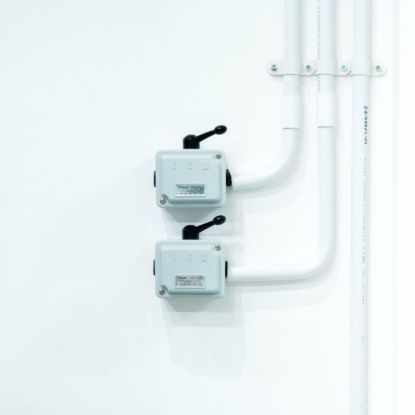
A rotary isolator gives a clear, local means of disconnecting equipment from its supply. This one has a three-pole switch inside a sealed polycarbonate enclosure, with a large red handle on a yellow plate that is easy to see and operate with gloves on. The handle shows a plain O for off and I for on.
In the off position the handle can be locked with up to three padlocks, so each person working on the equipment can fit their own lock. The lid cannot be opened while the switch is on, which stops anyone reaching live terminals.
Where to use it
The IP65 enclosure is sealed against dust and water jets, so the isolator can be mounted outdoors or in wash-down areas as well as in plant rooms.
- Air conditioning and heat pump outdoor units
- Pumps, fans and compressors
- Machine tools and conveyors in workshops
- Electric vehicle charge points and outdoor sockets
- Commercial kitchen and laundry equipment
Design and construction
The switch mechanism has a quick make and quick break action, so the contact speed does not depend on how fast the handle is turned. That reduces arcing and contact wear when switching motor loads. The enclosure is made from UV-stabilised polycarbonate, which resists impact and does not become brittle in sunlight.
Knock-outs for M20 and M25 glands are moulded in the top and bottom of the box, and the lid is held by captive screws with a full-length gasket.
- Three-pole switch, usable on single-phase or three-phase supplies
- Separate earth terminal in the enclosure
- Wall-mounting holes outside the sealed area
Choosing the right rating
Choose an isolator with a current rating at least equal to the rating of the protective device upstream. The 20 A model suits most domestic air conditioning units and small pumps. The 32 A model suits larger heat pumps, charge points and motors up to about 11 kW. The 63 A model suits sub-main supplies and heavy plant. For motor circuits, check the AC-23A power rating in the specifications.
Installation and care
Mount the isolator within sight of the equipment it controls. Use glands of the correct size and seal any unused knock-outs so the IP65 rating is kept. Fit drainage at the lowest point only if the manufacturer of the equipment requires it.
Operate the isolator from time to time so the contacts stay clean, and check the gasket and glands during routine maintenance. Replace the isolator if the enclosure is cracked, the handle is loose or there are signs of overheating at the terminals.
Compliance and ordering
The isolator is made to BS EN 60947-3, the standard for switch disconnectors, and is CE and UKCA marked. Each one comes boxed with fixing screws and a set of labels for identifying the equipment it controls.
Contractors fitting several units on one project, such as a row of air conditioning condensers, can add the quantity to a quick order or send the full list through the quote basket. Trade tier prices apply automatically, and the matching armoured cable and circuit breakers can go on the same order.
Demo product: invented for the Cartenvo B2B demo store.