Overview
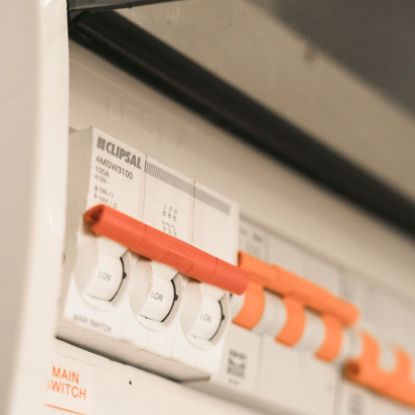
A miniature circuit breaker protects a circuit's cables against overload and short circuit, and it can be reset once the cause has been put right. This single-pole breaker is type B, which trips magnetically at three to five times its rating. That makes it the usual choice for domestic and commercial circuits with mainly resistive and lighting loads.
Each breaker is one module wide, 18 mm, and clips onto a 35 mm DIN rail. The rating is printed on the front and the toggle can be locked in the off position with a lock-off device, sold separately.
Where to use it
Use these breakers in consumer units and distribution boards designed for single-pole DIN-rail devices.
- Lighting circuits in homes and offices
- Ring final and radial socket circuits
- Immersion heaters, cookers and showers
- Sub-circuits in commercial distribution boards
- Replacing failed breakers of the same type and rating
Choosing the right rating
The breaker must be rated no higher than the current the circuit's cable can carry, and at least as high as the design current. As a guide, 6 A suits lighting circuits, 10 A suits larger lighting circuits and fans, 16 A suits immersion heaters and small radials, 20 A suits radial socket circuits in 2.5 mm² cable, 32 A suits ring final circuits and larger radials, and 40 A suits cookers and many electric showers.
Always confirm the rating from the circuit design and the earth fault loop impedance limits in BS 7671. Type B breakers need a lower loop impedance than type C to disconnect in time.
Design and construction
Inside the breaker, a bimetal strip responds to overloads and an electromagnetic coil responds to short circuits. An arc chute splits and cools the arc when the contacts open, which gives the breaker its 6000 A breaking capacity and energy limiting class 3. The housing is flame-retardant thermoplastic.
The terminals are rising-cage clamps that take cables up to 25 mm² and a pin-type busbar at the same time. A contact position indicator shows red when the contacts are closed and green when they are open.
Installation and care
Isolate the board at the main switch and prove it dead. Clip the breaker onto the rail, insert the busbar pin and tighten the terminal to the torque given in the specifications. Connect the circuit's line conductor to the outgoing terminal and label the circuit on the board schedule.
Exercise the breaker by switching it off and on during periodic inspection. If it trips repeatedly, investigate the circuit rather than fitting a larger rating.
- Fit only in boards designed for this breaker format
- Check the busbar type before ordering
- Work on consumer units must be done by a competent person
Compliance and ordering
The breakers are made to BS EN 60898-1 and are CE and UKCA marked. They come boxed singly with the rating on the end label, so they are easy to pick from a store. Contractors can order a mix of ratings in one quick order and keep a saved list for van stock.
Demo product: invented for the Cartenvo B2B demo store.